
India can stay relevant in Afghanistan not by being a bystander but by actively bolstering anti-Taliban forces monetarily, militarily and politically, say Lt Gen R K Sawhney and Sushant Sareen

China continues to hold out on fingering Pakistan as the 'mothership of terror,' declaring Masood Azhar a terrorist at the UN, and India's membership of the NSG, says China expert Srikanth Kondapalli.


'If the US intention was to use the FATF platform to isolate Pakistan and impose sanctions against it, that is not going to work when influential countries such as Turkey, Iran, Saudi Arabia, China and Russia will not lend support to the US campaign,' says Ambassador M K Bhadrakumar.

Brazil arrested 10 people on Thursday suspected of belonging to a poorly organised group supporting Islamic State (IS) and discussing terrorist acts during the next month's Olympic Games in Rio de Janeiro.

The State Department and the White House too said that the US expects Pakistan to take decisive action against terrorists operating from its soil.

'Will Muhammad Habib Zahir -- who was part of the team that arrested Kulbhushan Jadhav and went missing in Nepal -- figure in a Jadhav-for-Zahir deal?' asks Aditi Phadnis.

'The idea behind the new rules is that slaughter markets must buy directly from the farms as is the case in the bloody world.' 'The cattle markets have become centres for the organised beef mafia.'

Addressing the Indian diaspora on the second day of his three-day visit to Malaysia, Modi said India draws strength from its diversity and that his government is working to create an environment where enterprise flourishes and everybody gets basic needs like roof, sanitation, water, health care and education.

'Who in Pakistan was intending to carry out one of the most grievous acts of international terrorism just a few months ago?' Former CIA official Bruce Riedel reveals how the Lashkar-e-Tayiba and the ISI planned the attack on the Indian consulate in the Afghan city of Herat in May to take Indian diplomats hostage and disrupt Narendra Modi's swearing-in.

'Did Trump hint at US military intervention in Qatar?' asks Ambassador M K Bhadrakumar.

The million dollar question that begs for an answer is: Why is it that an amateurish attempt to convert a handful of Muslims by fringe Hindu elements garners so much attention while large scale systematic attempts to subvert Hinduism go unnoticed or are deliberately overlooked? If this is not double standards then what is, asks Vivek Gumaste.

Defying prohibitory orders, protests were held in Delhi, Bengaluru, Hyderabad and several other cities. Protesters, mostly students and activists, were detained on a large scale in national capital and other places.

The Bank of Japan's action has nullified the effects of the end of the US' quantitative easing programme but the dependence of foreign institutional investors remains a concern

With Beijing having had a profound rethink on India's admission as a full member of the Shanghai Cooperation Organisation, the tectonic plates of the geopolitics of a massive swathe of the planet stretching from the Asia-Pacific to West Asia are dramatically shifting. That grating noise in the Central Asian steppes will be heard far and wide -- as far as North America, says Ambassador M K Bhadrakumar.

New Delhi must indicate to Afghan President Ashraf Ghani that it has a long-term strategy for his country. It should point out that Pakistan's present Afgan policy will destabilise Afghanistan and help Islamic State, says Gautam Sen.

Imagine being a part of a country, but being discriminated against by the majority community and atrocities being committed against you by the state. This is the deplorable conditions that the Rohingyas of Myanmar live in where they are cut off from their livelihoods and sources of income, unable to access markets, hospitals and schools, and have little or no access to relief aid. In order to understand the situation and the genesis of the tragedy unfolding, Rediff.com's Archana Masih speaks to Ambassador Vijay Nambiar, the United Nations' Chef de Cabinet (Chief of Staff), who had served a long stint with the UN in New York on the issue.

Trupti Desai's fight earned women the right to enter the inner sanctums of the Shani Shingnapur Temple, the Trimbakeshwar Shiva Temple and the Haji Ali Dargah. Her next target is Sabarimala in Kerala. Aditi Phadnis reports.

'The surge of Saudi nationalism is the last thing Washington wants,' says Ambassador M K Bhadrakumar.
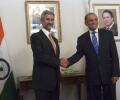
Pakistan's holy trinity -- its government, military establishment and the ISI -- differ on Pakistan's domestic and foreign policy issues. So when India talks to Pakistan's political leadership it can't be sure that the promises can be delivered, says Brigadier S K Chatterji (retd).
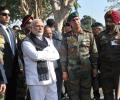
'The attack on the Pathankot base constituted an act of war. Yet Modi's only public comment up until now on that attack has been to blame it on "enemies of humanity".' 'Modi came to power talking tough about Pakistan. But in office, he has pursued a Pakistan policy that has lost both direction and purpose,' argues Brahma Chellaney.

'The diplomat's arrest has led to a major diplomatic spat, the likes of which I have not seen in my nearly three decades of covering the US-India relationship, says Aziz Haniffa. 'The knee-jerk reaction by the powers-that-be in Delhi was myopic to say the least.'

Raising the issue of cross border terrorism during his first visit to Turkey, a traditional ally of Pakistan, President Pranab Mukherjee on Tuesday said the menace must be dealt both "individually and collectively" as it was a threat to global peace.

A brainchild of Vishva Hindu Parishad leader Pravin Togadia, many find its agenda divisive

'Communalism and communal riots happened in India only during and due to colonialism. Pre-colonial India didn't have this problem of communal conflicts and religious strife.'

Countries in the region like Afghanistan, Pakistan and Maldives face serious existential threats from a mix of terrorist groups active in the region and elsewhere

'Under the present Defence Procurement Procedure, it would have been a nightmare, and a long, long one at that, to build 108 Rafales in India. Modi realised this and took the wise decision, though it is a definitive setback for his Make in India scheme.'

'One lesson to emerge out of the Modi-Putin summit is that India can be more self-confident that it possesses inherent strengths to leverage its interlocutors to influence Pakistani policies,' says Ambassador M K Bhadrakumar.

'Nitish is now a helpless junior ally of Hindutva.' 'He just cannot think of reining in the hoodlums raging, marauding and killing in the mohallas,' argues Mohammad Sajjad.

To persist with talks in the face of continuing terrorism that puts hundreds of Indian lives at stake is not only naive but morally repugnant and ethically unacceptable. It is time to see through this charade and abandon a path of high risk and no returns, says Vivek Gumaste.

The tragedy is that, at least on social media, the narrative that was being lapped up by many Indian Muslims was that Yakub Memon was being victimised. The purveyors of this poisonous line of thinking of course want this sentiment to grow since communal polarisation is the primary pillar of their political strategy, says Sushant Sareen.
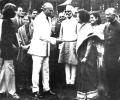
'Indira Gandhi, it appears, did not to consult her Cabinet colleagues, or diplomats, or civil servants when she decided to sign the agreement in Shimla.' 'We ruefully recall Bhutto's perfidy and the Indian prime minister's gullibility,' says Lieutenant General Ashok Joshi (retd).

The history of the Cauvery and Mullaperiyar cases has shown how helpless the constitutional processes and judicial verdicts have been in enforcing the law of the land in inter-state and state-Centre disputes, says N Sathiya Moorthy.
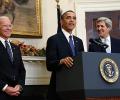
'The threat that India faces and the threat the United States faces is not just to the homeland, but to our people and to our institutions wherever they may be.' In an exclusive conversation with Aziz Haniffa/Rediff.com, US Assistant Secretary of State Nisha Desai Biswal outlines the importance of Prime Minister Modi's visit for America.
'India and China have to make concrete progress with regard to the border issue, addressing the trade deficit, and facilitating people-to-people interactions. This has to happen in the next two, three years.' China expert Tansen Sen tells Sheela Bhatt/Rediff.com how India and China can take their relations to the next level.

'The Indian government has accepted and is a party to international agreements, standards and conventions on religious freedom.' 'We did not force it on them. We are not trying to impose something on them that they haven't already agreed to...' 'India has never allowed us to visit, which is very disappointing for such a wonderful country with such a rich democratic tradition. They seem to be afraid to let us in.'

About 17 lakh investors, mostly in West Bengal, who have lost crores of rupees in the Saradha chit fund scam are fast losing hope. The scandal continues to roil West Bengal political circles with several ruling Trinamool Congress leaders being implicated and some arrested. Even West Bengal Chief Minister Mamata Banerjee's name has been dragged into the sordid mess. Indrani Roy presents a FAQ on what the scam is about and the main players behind it.
